

Good morning!
Nvidia just posted a quarter most companies couldn't dream of, and it still wasn't the only thing people talked about last night. Anthropic prices the biggest IPO in history tonight, we finally know what's been knocking out banks and airlines, and AI models just got a lot cheaper. Let's get into it.
📊 MARKETS
Fourth red day in a row for the S&P 500, but futures are finally green.
Nasdaq: 24,328.38 ↓0.74%
S&P 500: 7,340.53 ↓1.03%
Dow: 50,759.42 ↓1.64%
10-Year Treasury: 5.10%, down about 3 basis points
Bitcoin: about $64,600, near its lowest level in almost three months
The Dow lost about 850 points and the S&P closed at its lowest level since late July. The Nasdaq was down as much as 2.1% at one point, touching its lowest level since April. A builder confidence index also dropped to a 14-year low, which didn't help.
This morning Nasdaq-100 futures are up about 1% and S&P futures about 0.5%. The Fed releases its meeting minutes today, and traders are pricing in a December rate hike as close to a sure thing.
🟢 NVIDIA DIDN'T NEED JENSEN TO BEAT. IT MIGHT NEED HIM FOR EVERYTHING ELSE
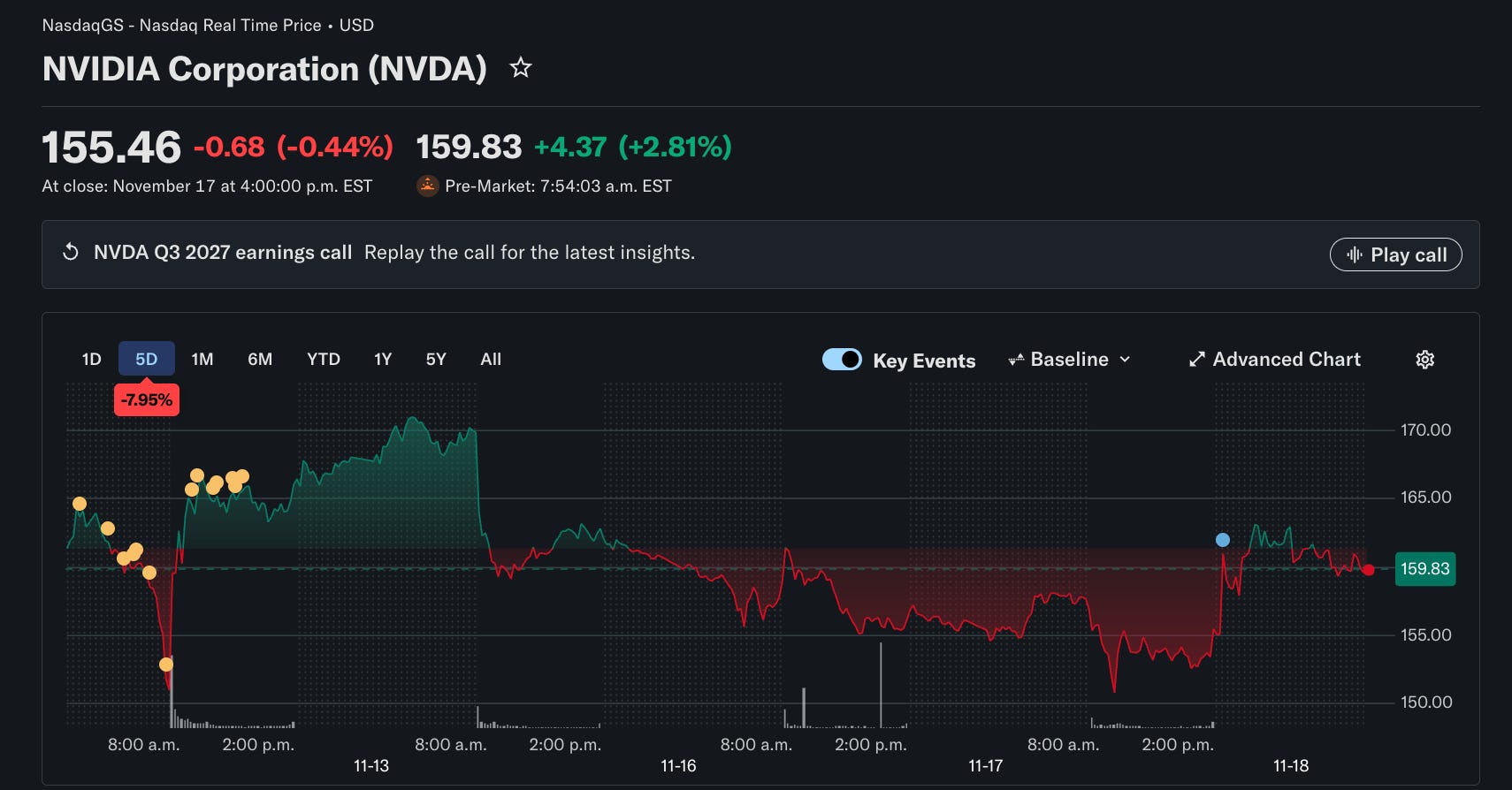
The numbers were huge. Revenue hit $115.8 billion, up 103% from a year ago and about $6.7 billion above estimates. Data center revenue alone was $107.6 billion. Net income came in at $65.3 billion. For this quarter, Nvidia guided to about $130 billion, plus or minus 3%, versus roughly $125 billion expected.
Interim CEO Colette Kress also raised next fiscal year's growth target to about 75%, up from 70%, and the board added $150 billion to the buyback. The stock closed at $155.46 before the report and traded up 3% to 5% after it.
The catch: part of that guidance is an extra week in the fiscal quarter, which one analyst estimates adds $9 billion to $10 billion. Still, supply commitments jumped to $390 billion from $279 billion in three months. Nobody signs that if demand is slowing.
The bigger story: everything around the numbers. Board chair Harvey Jones opened the call by saying the board unanimously accepted Jensen Huang's resignation and does not intend to bring him back, even though Huang said hours earlier he'd be "honored" to return. A search firm is now hunting for a permanent CEO. The same afternoon, the Wall Street Journal reported the SEC opened a civil probe into whether Nvidia's disclosures misled investors, and the company said its quarterly filing will be delayed.
Kress also said Nvidia will stop selling H200 chips in China, ending the Huang-Trump arrangement where Washington took a 25% cut. China was only about 2% of sales this quarter, so the revenue hit is small. And she promised to be "disciplined and selective" about backing neoclouds, which, funny enough, sent CoreWeave and Nebius up 9% premarket.
My take: the business is fine. Better than fine. What I'd worry about is the stack of investigations and a CEO chair that's empty. Great quarters buy patience, but only for so long.
🦄 ANTHROPIC PRICES THE BIGGEST IPO EVER TONIGHT
Anthropic is selling 825 million shares at a marketed range of $70 to $78, and it's telling investors to expect the top of that range or higher. Orders reportedly came in at close to seven times the shares on offer, with several single bids of $10 billion or more. The books closed yesterday afternoon. Pricing is tonight, and the stock starts trading on Nasdaq tomorrow under the ticker ANT.
At the top of the range, and counting a $26 billion private placement from Google, Nvidia, AMD, Broadcom, Micron, Microsoft and TSMC, the deal raises about $90.4 billion. That would make it the largest IPO ever. Some reports say the price could land above $80, which would put the valuation around $1.5 trillion to $1.6 trillion. Back in May, private investors valued it at $965 billion.
The number that jumped out at me: at the midpoint, the average Anthropic employee's equity is worth around $72 million. That's going to reshape San Francisco real estate, angel investing and a lot of startups' hiring plans for years.
My take: up to 20% of the shares are going to retail investors, which is generous for a deal this hot. But after a month where AI stocks got hammered, pricing this high is a statement. If ANT trades well tomorrow, the AI trade gets a second wind. If it breaks issue, look out.
🔧 WE FINALLY KNOW WHAT BROKE THE BANKS AND THE AIRLINES
After a week of outages, from the nationwide flight ground stop to banking glitches to a classified NSA network going down, Wall Street executives and the NSA have told members of Congress what happened. It wasn't an attack. It was patching.
AI models are now finding serious security holes so fast that companies and agencies feel they have to fix them immediately, before bad actors with similar tools find them first. So they're pushing through more patches at once than their old systems were built to handle, and things fall over. "They're trying to push through a lot of patches all at once," one congressional official said.
The ground stop alone led to more than 20,000 canceled flights. The FAA has now paused installing a type of router officials believe played a part, though the maker says its device wasn't defective. The Homeland Security secretary summed it up: new technology on top of really old computer systems "just seems to overwhelm the system."
My take: this is the side of AI nobody pitched in the keynotes. The same models that make defense better are forcing a decade of deferred maintenance into a few months. If you run any infrastructure on legacy code, the question isn't whether AI finds your holes. It's whether your team can patch them without breaking production.
💸 THE AI PRICE WAR JUST GOT SERIOUS
OpenAI launched GPT-6.2 Astra and Sol yesterday. Astra, its top model, costs 20% less than the last version in the API, at $8 per million input tokens and $40 per million output tokens, with cached input down to $0.40. Sol stays at $2 and $10. One independent ranking puts Astra second, behind only Anthropic's newest model.
The same day, Microsoft rolled out seven of its own models at its Ignite conference. The headliner is MAI Code 2, which Microsoft says delivers 98% of the coding quality of OpenAI's GPT-6.1 Sol at about 40% of the price, and 96% of Anthropic's Opus 5.5 at roughly 5% of the price. Those are Microsoft's own benchmarks, and the launch price is a promo that doubles in May. It's live in GitHub Copilot now.
Why it matters: Microsoft is OpenAI's biggest partner and now openly undercuts it. For anyone building on AI, the cost of running an agent all day is falling fast.
My take: this is great news for every startup and a headache for anyone charging premium prices for a model. The winners won't be whoever tops a benchmark by two points. They'll be whoever gets a task done for the fewest dollars.
📣 APPLOVIN WANTS A PIECE OF RETAIL MEDIA
AppLovin is among the companies in talks to buy Criteo, the Paris-based ad tech firm, according to two people familiar with the matter. No price has surfaced. Criteo has been exploring a sale since a joint approach from Vista Equity Partners and Quinti Capital over the summer.
Criteo's stock has lost more than half its value over five years, leaving it worth about $1 billion. AppLovin is worth roughly $136 billion. Criteo shares jumped as much as 10% on the report and then closed down about 5% as the market sold off. AppLovin fell 3.9%.
Why it matters: Criteo is best known for the ads that follow you around after you visit a store's website, and lately it's been leaning hard into retail media, ads sold on retailers' own sites and apps. AppLovin built its machine in mobile games and has been pushing into e-commerce.
My take: as someone who runs an ad network, this one makes sense to me. Criteo has the retailer relationships and data, and AppLovin has the performance engine. For less than 1% of its own market value, AppLovin could buy a shortcut into the fastest-growing corner of digital ads.
🚕 WAYMO JUST LOST THE FREEWAY
California's DMV has banned Waymo robotaxis from every freeway in the state, calling its driverless freeway operations "an imminent hazard to public safety." The order took effect November 11 but only became public yesterday.
The DMV pointed to two incidents: three Waymos driving into an active construction closure on Highway 101 near Burlingame, and a viral video of a Waymo trying to get around a highway patrol traffic break on I-280 in San Francisco. Waymo responded by pausing freeway rides in all of its US markets, including Phoenix, Miami and Austin.
My take: city streets are where Waymo has earned trust. Freeways were the next leg of growth, especially for airport runs. This isn't fatal, but construction zones and police officers are exactly the messy edge cases robotaxis have to master before anyone hands them the highway again.
🌍 A FEW OTHER THINGS ON THE RADAR
Trump and Xi: The two leaders are set to meet again at the APEC summit in Shenzhen, their third meeting this year, with chips and trade at the top of the list.
Ramp: The corporate card startup is reportedly in early talks to raise $1 billion or more at a valuation above $70 billion, its third round in a year.
Kalshi: Regulators ordered it to stop offering markets on what Trump says during public events.
Google: Gemini will now keep temporary chats and chats with history turned off for about two months, up from 72 hours.
Uber and Zipline: Autonomous drone deliveries for Uber Eats just started in Spring, Texas, with a goal of 1 million deliveries a day by the end of 2029.