

Good morning!
Congress wants a closed-door conversation with the CEO of the world's most valuable company, the Nasdaq finally bounced, OpenAI got its $11 billion, and a hot jobs number put the Fed back in play.
Let's get into it.
📊 MARKETS
Tech caught a bid on Friday, but nobody is calling it healed.
Nasdaq: 24,579.42 ↑1.09%
S&P 500: 7,376.86 ↑0.31%
Dow: 51,285.73 ↓0.46%
10-Year Treasury: 4.86% ↑2 bps
Bitcoin: about $75,900, roughly flat
Buyers stepped into the chip names that got crushed on Thursday. Nvidia gained nearly 3% after a 9% drop, AMD jumped 9%, and Micron rose 5%. For the week, the Nasdaq still lost 3.4%, the S&P 500 lost 2.7%, and the Dow lost 0.9%. One bounce does not erase a correction.
🕵️ CONGRESS WANTS JENSEN HUANG IN A CLOSED ROOM
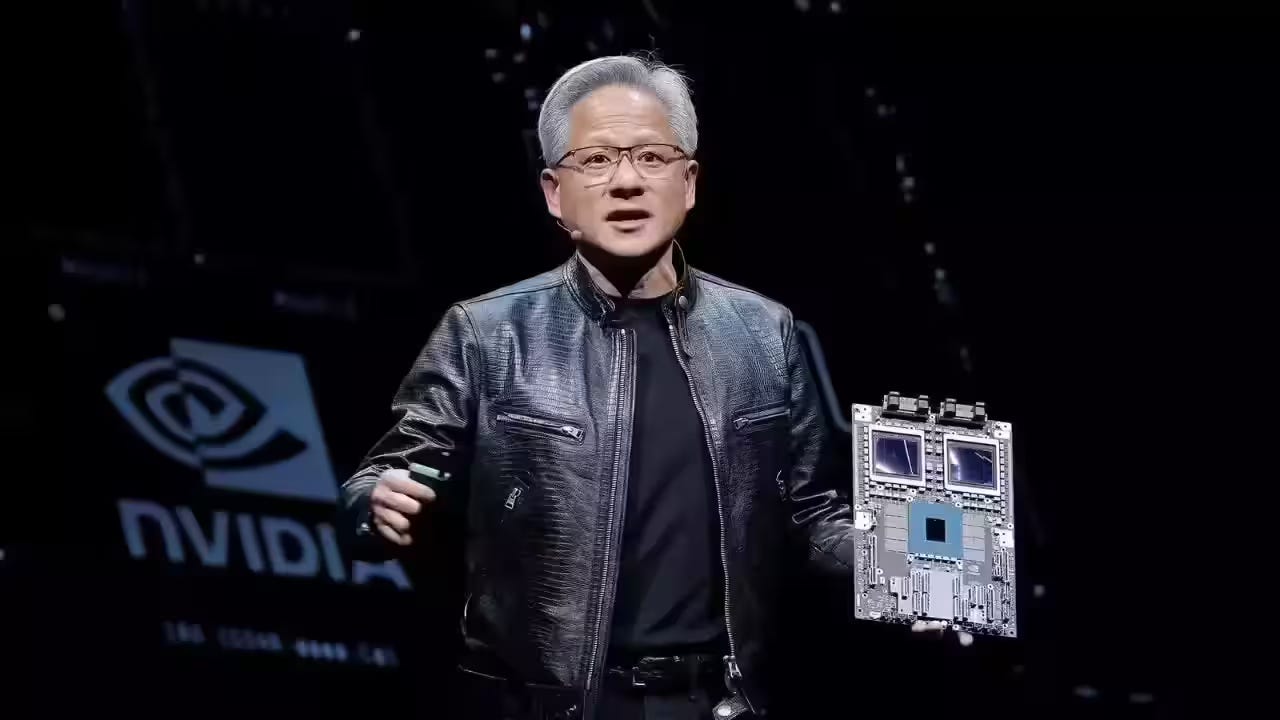
Three House committees have asked Nvidia CEO Jensen Huang to brief them behind closed doors on November 18. The subject is his interactions with Alice Huang, an executive at Megaspeed, which is one of Nvidia's customers. The two are not related.
Here is the new part. According to The New York Times, China's Ministry of State Security recruited her to learn about American AI chips and potentially push Nvidia to make its most advanced ones available to China. She also reportedly knows executives at the highest levels of the chip industry, including leaders at Gigabyte.
The Times says President Trump was briefed on the relationship last year and took no action. The committee chairmen (Mast, Moolenaar, and Crawford) want an answer on the date by November 11 and a look at Nvidia's security protocols against foreign espionage.
The catch: Almost all of this comes from anonymous sourcing and one newspaper's reporting. Nothing here says Huang knowingly helped anyone. Being a target of an intelligence service is not the same as being a participant.
The bigger story: Nvidia is the single point everything in the AI trade hangs from. A CEO distracted by Congress, a possible tightening of export rules, and a customer list that suddenly needs scrutiny is a lot of new risk for a stock that just spent a week proving how fragile sentiment is.
My take: If you run a company this big, your relationships are not private anymore. I would expect Nvidia to answer this fast and in detail, because silence will cost more than the briefing will.
📈 THE DIP BUYERS SHOWED UP, BUT THE REASONS HAVEN'T CHANGED
The reasoning behind the rebound is simple. Bank of America's Wamsi Mohan argued that Thursday's rout came from valuation multiples shrinking, not from earnings estimates falling. Their 2028 profit forecasts for the group are still at or above consensus. In other words, the story is that stocks got too expensive, not that the business broke.
Chris Grisanti of MAI Capital called AI an industrial revolution on par with railroads and the internet and said it will not stop. Trump jumped in on Truth Social, saying he is 100% for the AI buildout and calling data centers "GOLD.”
The catch: The political risk didn't go anywhere. Texas governor-elect Gina Hinojosa said on CNN that the state needs laws to protect Texans and that data center buildout should stop until they exist. She doesn't take office until January, which gives the market two months to keep worrying.
The bigger story: Microsoft also reportedly plans to cut the number of neocloud partners it works with, and Bloomberg says it has let a rented Oracle capacity deal lapse. Oracle fell about 2% on that. Gartner says as many as 80% of neoclouds could stop operating independently by 2030.
My take: Cheap money built the neocloud model and it only works while capital keeps flowing. I would be a buyer of the platforms with cash flow and a skeptic of anyone whose business plan is renting chips with borrowed money.
💰 OPENAI JUST RAISED $11 BILLION, AND ANTHROPIC'S IPO IS NEXT
OpenAI has closed an initial $11 billion of a round at a $1.25 trillion valuation, which CNBC confirmed. It could take in up to another $9 billion over the coming weeks. CFO Sarah Friar said "a good CFO always raises money when she can."
She also told CNBC that the election results won't slow OpenAI's data center spending, and that the company is still eyeing a 2027 IPO.
Anthropic wants to list first. It is targeting the Nasdaq in mid-November, with a roadshow expected as soon as next week. Its filing shows revenue of $33.2 billion for the first nine months of the year and about $895 billion of compute and infrastructure commitments.
The catch: After this week's selloff, some investors reportedly think Anthropic's $1.5 trillion target is a stretch. Reports put buyers' comfort zone anywhere from $1 trillion to $1.1 trillion.
The bigger story: The two biggest private AI companies are in a race to the public markets just as public AI valuations get repriced. Whoever lists second gets to learn from how the first one trades.
My take: Raising at $1.25 trillion this week is a statement. OpenAI wants cash in the bank before the public market makes up its mind. I would do the same.
💼 THE JOBS REPORT THAT PULLED THE FED BACK INTO THE ROOM
The US added 165,000 jobs in October. Economists expected about 59,000. The unemployment rate dipped to 4.1% from 4.2%, and August and September were revised up by a combined 84,000.
That sent yields up and rate-cut hopes down. Traders now put the odds of a December rate hike at roughly 77%, up from about 66% the day before. The dollar rose around 0.7%.
The catch: Consumers sound shakier than the data. The University of Michigan sentiment index came in at 51.0, better than expected, but its director noted sentiment fell 5% among people with the largest stock portfolios. Cost of living still dominates, and AI bubble worries are showing up in what people say.
The bigger story: A stronger labor market is good news for the economy and bad news for anyone hoping rates come down to rescue valuations. Stocks are being valued on a higher-for-longer world.
My take: From where I sit, running ads, strong hiring usually means advertisers keep spending. I would rather have this problem than a weak jobs print.
✂️ CANVA'S LAYOFFS ARE A MASTERCLASS IN HOW TO EXIT PEOPLE
Canva is restructuring in a way that affects 1,271 people, or 22% of its staff. Some will lose their jobs, some will change roles, and some will be asked to move to central hubs. The company hasn't said how many are leaving. CEO Melanie Perkins called it the hardest moment in the company's 13-year history and said growth slowed for the first time in a decade.
What got attention was the exit package. Everyone leaving gets at least six months of salary regardless of location, 12 months of healthcare where Canva provides it, career coaching, a year of LinkedIn Premium, and their MacBook. The one-year vesting cliff is gone for recent hires.
The catch: A good severance does not change that the company is cutting because growth slowed and AI costs are climbing. Design software is one of the categories AI image tools are squeezing.
The bigger story: Canva is reportedly eyeing an IPO, and how it treats departing staff will matter to future hires and to public investors.
My take: If you have to cut, this is how. People remember how you handled the worst day, and so does everyone you want to hire next.
🌍 A FEW OTHER THINGS ON THE RADAR
LIV Golf is done. Lawyers told a New Jersey bankruptcy court the league is moving to liquidation after BC Partners walked away from a $300 million rescue. More than $5 billion was spent in five years, and the wind-down is set to start Monday.
Oil took a beating this week. Brent was near $98.65 on Friday after falling about 16% over the week, and WTI was near $91. S&P 500 energy was heading for a loss of nearly 12% on the week on hopes of a Middle East resolution.
Earnings movers: IonQ rose 17% after raising 2026 revenue guidance to $505 million to $515 million. Lam Research jumped about 11% on a $25 billion buyback. Microchip fell 14% on soft guidance. Moderna gained nearly 10% after raising its outlook.
Firefly Aerospace surged nearly 30% on a roughly $1.3 billion deal to supply AST SpaceMobile with 36 rocket engines and a license to the engine design.
SpaceX shares rose about 6% early Friday after dropping nearly 13% on Wednesday and Thursday. Deutsche Bank called it a buy-the-dip opportunity despite political risk for Elon Musk.
Five9 fell more than 17% premarket after cutting its full-year profit guidance and announcing a $325 million cash deal for Level AI.