

Markets are looking a little nervous, Canada is making a pretty aggressive pitch for new investment, and AI keeps finding its way into areas that have very little to do with chatbots.
Here are the stories worth knowing today.
📈 Markets are waiting on the Fed
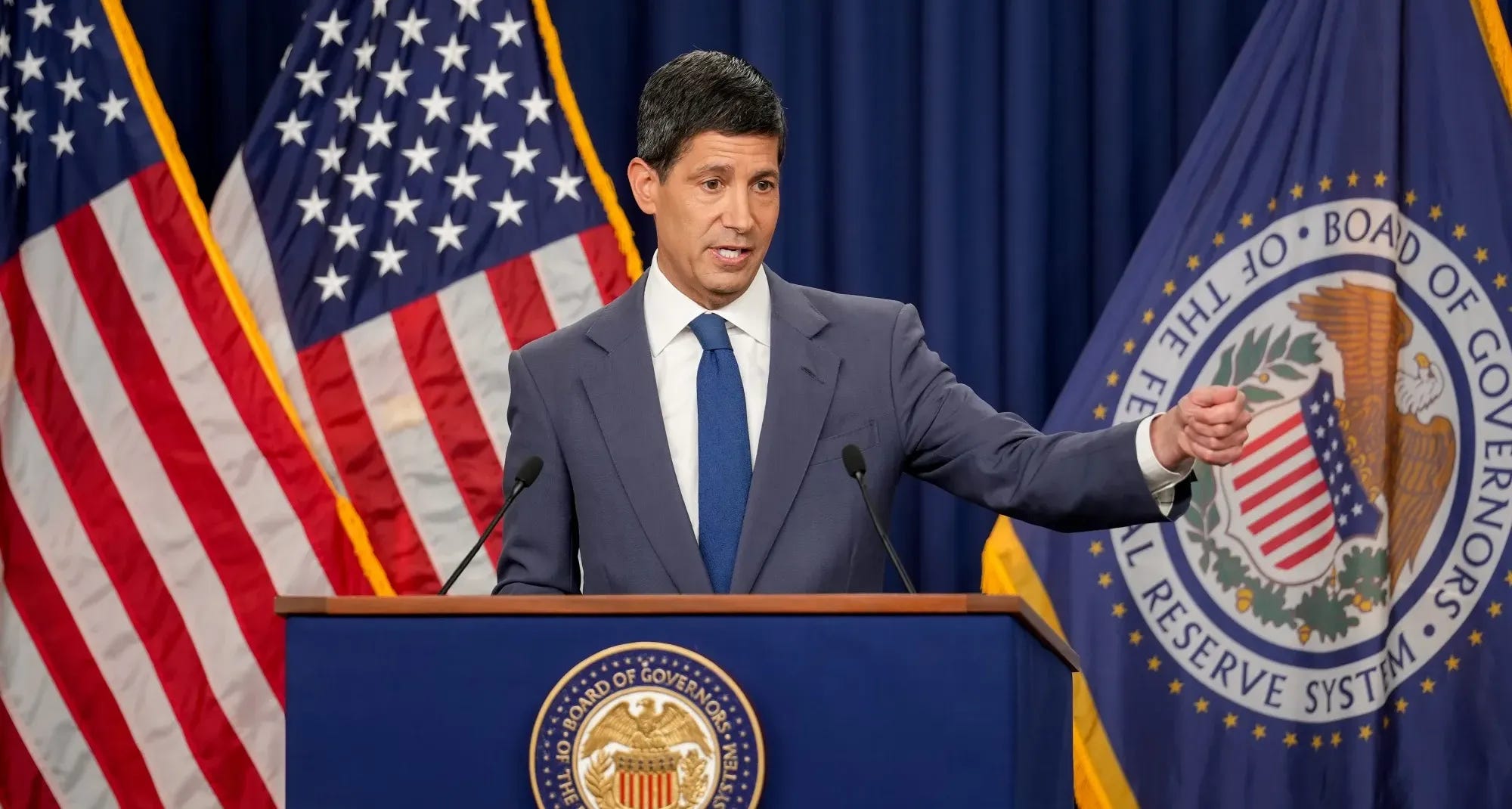
Wall Street had a rough session yesterday as investors positioned themselves ahead of today’s Federal Reserve interest-rate decision.
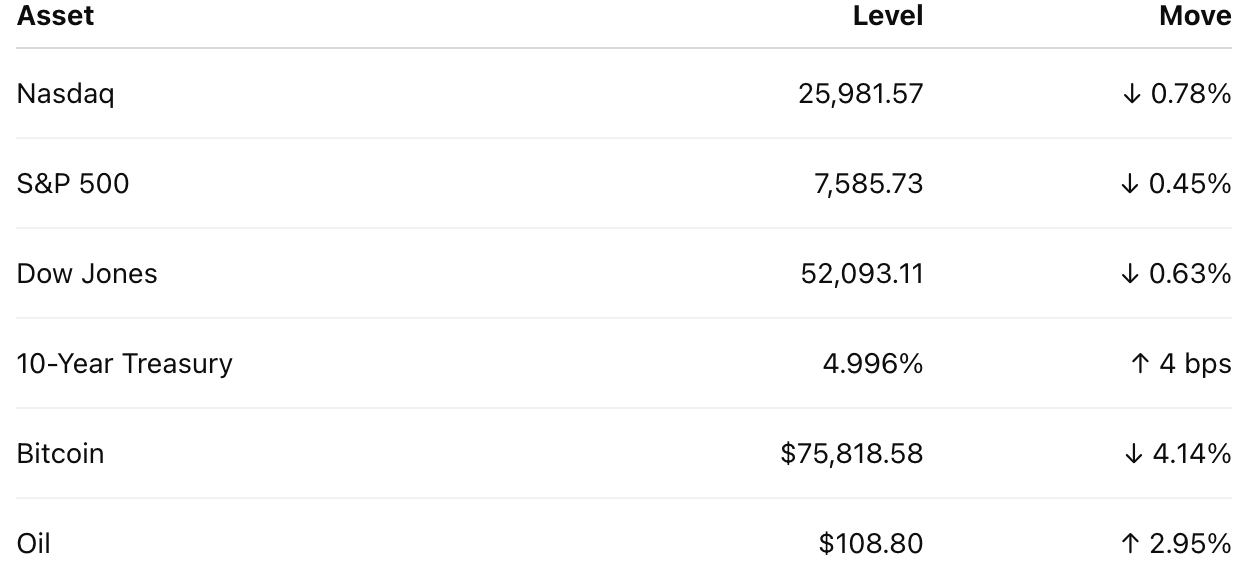
The S&P 500 fell 0.45%, the Nasdaq dropped 0.78%, and the Dow slipped 0.63%.
Oil moved in the opposite direction, climbing almost 3% to around $108.80 a barrel. The 10-year U.S. Treasury yield also pushed higher, briefly reaching 5.04% — its highest level in nearly two decades.
Bitcoin wasn’t exactly helping the mood either, falling more than 4% to roughly $75,800.
Yesterday’s market snapshot
The bigger issue is inflation.
Recent inflation data came in hotter than expected while energy prices have been pushed higher by the conflict in the Middle East. Markets have therefore been preparing for the possibility that rates could stay higher for longer.
The 10-year Treasury yield is particularly important because it feeds into everything from mortgages to corporate borrowing costs.
The simple takeaway: investors are watching two things at the same time — whether inflation is actually cooling and whether expensive oil starts making that job harder.
🇨🇦 Canada is making a much bigger bet on investment
Canada just unveiled one of its most aggressive attempts in years to make business investment more attractive.
The federal government announced a new Productivity Mega Deduction, which would allow businesses to immediately write off a much larger share of new capital investments.
Under the proposal, roughly two-thirds of capital investment could qualify for immediate expensing, compared with about 15% under the existing rules. The estimated fiscal cost is about $36 billion over five years.
That is a pretty big change.
The idea is straightforward: instead of making a company wait years to deduct the cost of a new machine, piece of equipment or other eligible investment, the tax system lets it deduct the cost much sooner.
The headline numbers
Eligible investment
Current system: ~15%
New proposal: ~⅔
Canada’s marginal effective tax rate on business investment
Before the new measure: about 13%
After the measure: 6.4%
The government says the change is intended to make Canada more competitive for large projects and encourage companies to put more money into equipment, technology and infrastructure.
And there are some very large projects in the pipeline.
The investment push includes things such as AI data centres, pipelines, mining projects, transportation infrastructure and other major developments.
Canada is essentially saying: if you’re going to spend billions building something, we want you to seriously consider doing it here.
The catch
Tax deductions aren’t free.
Ottawa estimates the measure will cost about $36 billion over five years, with the expectation that the additional investment and economic activity will eventually make up for some or all of that lost tax revenue.
Whether that actually happens is the interesting part.
The government is targeting a huge increase in investment, so the next few years will tell us whether the incentives translate into actual projects rather than just better-looking tax spreadsheets.
✈️ Canada’s airports are also opening the door to private capital
The investment push doesn’t stop at tax policy.
Canada is also looking to bring private investment into its four largest airports:
Toronto Pearson
Vancouver International
Montréal-Trudeau
Calgary International
The federal government says it would retain ownership of the underlying airport land and assets while allowing private capital to participate.
That matters because Canadian pension funds have already become major investors in infrastructure around the world.
The broader message is pretty clear: Canada wants more private capital involved in building and expanding major infrastructure instead of relying entirely on government spending.
And the country is pitching investors on a much bigger opportunity overall — potentially around $1 trillion in investment over the next five years.
🤖 Canada could also become an AI infrastructure hub
Another interesting piece of the investment story: Canada is increasingly being viewed as a potential home for large AI data centres.
The attraction is fairly obvious — Canada has large amounts of land and energy, two things that become increasingly important as AI companies build enormous computing infrastructure.
At the same time, Nvidia and Salesforce have introduced a new reasoning model aimed specifically at business applications such as sales, marketing and customer support.
The interesting trend here isn’t necessarily one particular AI model.
It’s that AI companies are increasingly building specialized systems for specific industries and jobs, rather than trying to create one giant model that does everything.
That could make AI cheaper and easier for businesses to actually deploy.
🏠 Airbnb wants to get into the housing supply problem
Here’s a slightly unexpected development.
Airbnb is launching a $250 million fund aimed at helping finance affordable housing projects in the U.S.
The initial plan involves providing bridge financing to multifamily rental developments that have stalled and may not be completed without additional funding. The company says the program could eventually expand internationally.
It’s an interesting move because short-term rental platforms have spent years dealing with criticism over their relationship with housing affordability.
Cities including Toronto, Vancouver and Montreal have tightened short-term rental rules partly because of concerns about long-term housing supply.
Now one of the biggest companies in the short-term rental industry is putting money toward actually building housing.
Whether $250 million makes a meaningful dent in the problem is another question. But the shift in strategy is worth watching.
🇯🇵 Japan has a very different demographic problem
Japan has now passed a milestone that would have sounded almost unbelievable a few decades ago:
More than 100,000 people in the country are aged 100 or older.
The latest figure is about 107,677 centenarians, and nearly 90% are women.
The bigger story isn’t simply that people are living longer.
It’s that Japan is simultaneously dealing with extremely low birth rates.
That combination creates a difficult economic equation: more retirees, fewer working-age people and increasing pressure on healthcare, pensions and elder care.
Japan estimates it will need about 2.4 million elder-care workers in 2026, compared with roughly 2.1 million in 2024.
The country is therefore turning increasingly to foreign workers to fill care-related jobs.
Japan’s demographic squeeze
107,677
People aged 100+
2.4 million
Elder-care workers needed in 2026
~⅓
Share of the population receiving public pensions
This is becoming much more than a demographic story.
It affects government budgets, immigration policy, healthcare, wages, productivity and the availability of workers across the economy.
And Japan is basically a preview of a problem many other developed countries will eventually have to deal with.
🔐 AI is creating another unexpected winner: cybersecurity
There’s a strange side effect to the AI boom.
As AI systems become more capable, investors are becoming increasingly concerned about what happens when those same capabilities are used by hackers.
That has pushed cybersecurity stocks higher.
CrowdStrike and Palo Alto Networks were both up sharply this week, while a Nasdaq cybersecurity ETF has gained nearly 40% since the beginning of the year, according to the figures reported yesterday.
The spending story may be even more important.
Industry forecasts cited in the newsletter put global cybersecurity spending at roughly $51 billion this year, potentially rising to $86 billion by 2027.
In other words, companies aren’t just buying AI.
They’re increasingly buying the security systems needed to deal with what AI can do.
🚀 The U.S. just acknowledged weapons are already in orbit
The U.S. military has confirmed that it has deployed what it describes as on-orbit space control weapons.
Officials did not provide details about exactly what systems are in orbit or where they are located.
The announcement came as the U.S. military focuses more heavily on threats involving satellites and other space-based systems.
The significance is bigger than the headline itself.
Modern militaries depend heavily on satellites for communications, navigation, surveillance and targeting. That makes space infrastructure increasingly important — and increasingly vulnerable.
The Pentagon has been preparing for years to counter the growing space capabilities of countries including China and Russia.
Space is becoming another serious military domain, and the competition is clearly moving beyond simply putting satellites into orbit.
🏛️ A few other things happening
The Kennedy Center is heading toward a major closure.
Its board voted to shut the main building amid financial and legal disputes. The decision came shortly after a federal judge blocked efforts to add President Trump’s name to the building without congressional approval.
A major crypto bill hit a roadblock.
The Senate voted 49–50 against advancing legislation that would have created a federal regulatory framework for digital assets. The debate included disagreements over ethics provisions involving President Trump and his family’s crypto interests.
A Canadian car-sharing company reported a data breach.
The incident was attributed to an employee, according to the company’s disclosure.
AI is even getting into photo posing.
A new app created by former TikTok executives uses AI to analyze a selfie and suggest poses for the person to copy. Basically, an AI coach for people who never know what to do with their hands in photos.