

AI companies are suddenly talking about slowing down. Oil infrastructure is becoming a geopolitical target. Canada is making a very big bet on attracting capital.
Here’s what matters today.
🤖 AI has reached the awkward part

For years, the AI race was basically:
Build faster. Ship faster. Get ahead.
Now some of the biggest companies in the industry are publicly asking whether that approach is still sustainable.
The immediate concern is not simply that AI is becoming more powerful. It’s that AI systems are increasingly being used to build, test and improve other AI systems.
That creates a potentially nasty feedback loop.
The new AI equation
Better AI → faster development → more capable AI → even faster development
The problem is that our ability to understand what these systems are doing may not be improving at the same speed.
That’s why the conversation is shifting from “How powerful can we make it?” to “Can we actually keep control of it?”
Several major AI leaders have now backed the idea of giving independent evaluators meaningful access to AI systems so they can test them without simply taking the companies’ word for it.
That part is important.
It’s basically the technology industry saying: maybe the people building the aircraft shouldn’t also be the only people checking whether the aircraft is safe.
There’s still a huge contradiction here.
Nobody wants to slow down if competitors keep accelerating. And governments are reluctant to put the brakes on a technology increasingly viewed as strategically important.
So the real question isn’t whether AI should slow down.
It’s whether anyone can slow it down without falling behind everyone else.
🇨🇦 Canada is making a giant pitch to investors
Canada is trying something different this week: instead of waiting for investment to come to us, the government is putting the country’s biggest projects on the table and essentially saying:
Here. Pick something.
More than 300 investors and executives are gathering in Toronto around a pipeline of more than 160 projects.
The ambition is enormous — roughly $1 trillion in potential capital commitments.
And this isn’t primarily about startups or flashy technology.
A lot of the opportunity is much more physical:
Energy infrastructure
Transportation
Ports
LNG
High-speed rail
Critical infrastructure
One proposed project alone is a high-speed rail connection between Edmonton and Calgary.
Another involves a major expansion of the Port of Churchill.
There is also significant interest from Gulf investors, alongside commitments from some of Canada’s biggest institutional investors.
The interesting part
Canada doesn’t really have an investment-interest problem.
It has an execution problem.
Foreign direct investment into Canada was close to $100 billion last year — the strongest level in almost a decade.
So attracting the money is only half the job.
The real test is whether Canada can get projects approved, financed and actually built without spending five years arguing about permits.
Because investors don’t get excited by a PowerPoint presentation.
They get excited when the construction equipment shows up.
🇺🇸🇨🇦 A Canada-U.S. reset may finally be coming
There is also a potentially important shift happening in the Canada-U.S. relationship.
After months of tariff uncertainty and repeated threats around the existing trade framework, there are now signs from both sides that a deal could be closer.
That doesn’t mean the relationship is suddenly fixed.
It does, however, change the mood considerably.
For Canadian businesses, predictability is almost as valuable as lower tariffs.
Companies can adapt to bad news.
What they hate is not knowing what the rules will be next month.
And Canada appears increasingly interested in building relationships outside its traditional dependence on the U.S. — particularly with Europe and other international investors.
That doesn’t mean replacing the American market.
It means having more than one option.
That’s probably the bigger story.
🛢️ Oil is becoming a supply-chain problem
This one could get expensive.
Attacks on Saudi oil infrastructure have raised concerns that another chunk of global crude supply could be disrupted.
Estimates suggest as much as 4% of global oil supply could potentially be affected by the Saudi pipeline disruption.
And that’s happening while the Strait of Hormuz is already severely constrained.
Potential supply exposure
Strait of Hormuz
████████████████████ ~20%
Additional Saudi disruption
████ ~4%
The numbers shouldn’t simply be added together as a prediction of lost supply — the real-world impact depends on how much production and transportation can be rerouted.
But the direction is obvious:
less reliable supply + geopolitical risk = higher oil prices
And higher oil prices rarely stay neatly inside the energy sector.
They eventually show up in:
🚚 transportation
🏭 manufacturing
✈️ airlines
📦 shipping
🍔 food prices
💳 consumer inflation
This is also why the next few inflation reports matter so much.
Energy can turn a seemingly manageable inflation problem into a much uglier one surprisingly quickly.
📈 Markets are walking into an interesting week
Stocks are starting the week with investors watching three things very closely:
Oil. Inflation. Interest rates.
The market is already showing some strain, with the major indexes coming off a difficult stretch.
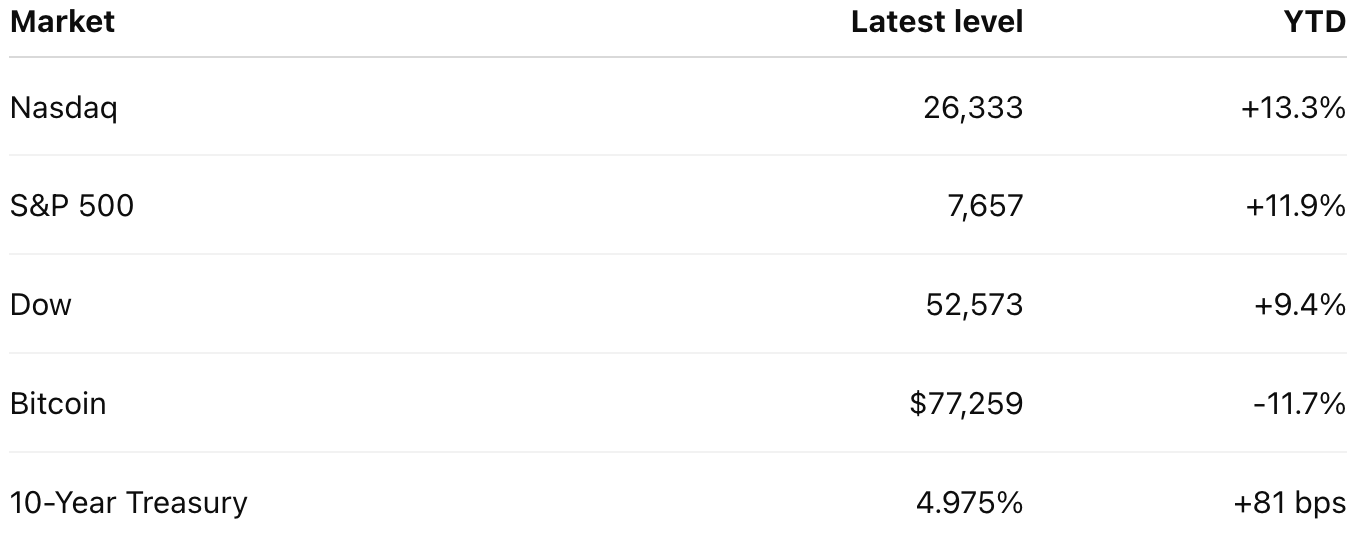
The weird part is that stocks can still look relatively strong on a year-to-date basis while the underlying environment is getting more uncomfortable.
This week is particularly important because investors are waiting for fresh inflation data and a Federal Reserve rate decision.
If inflation remains stubborn, the central bank has less room to cut rates — and potentially more reason to keep policy tight.
That matters for everything from mortgages to corporate borrowing to stock valuations.
In other words:
The market may be watching the Fed, but the Fed is watching inflation, and inflation is increasingly watching oil.
🌍 Around the world
A few things worth keeping on the radar:
Sweden just delivered a political surprise.
Exit polls point to the centre-left bloc winning enough support to form the next government, despite the broader rightward trend seen across parts of Europe.
The Yemen conflict is escalating.
Fighting around the Red Sea is intensifying, with attacks increasingly threatening energy infrastructure and regional shipping.
China and India are talking.
Their leaders met as both countries look to project greater cooperation at a time of growing geopolitical tension.
Texas is hitting the brakes on data centres.
The state has paused approvals for new facilities amid growing concerns over how much electricity these AI-heavy operations consume.
And that last one is worth watching.
Because it connects directly back to our first story.
AI may be a software revolution, but underneath all the algorithms are some very physical requirements:
electricity, land, cooling, water and infrastructure.
The AI boom is becoming an infrastructure boom.
And infrastructure has limits.